
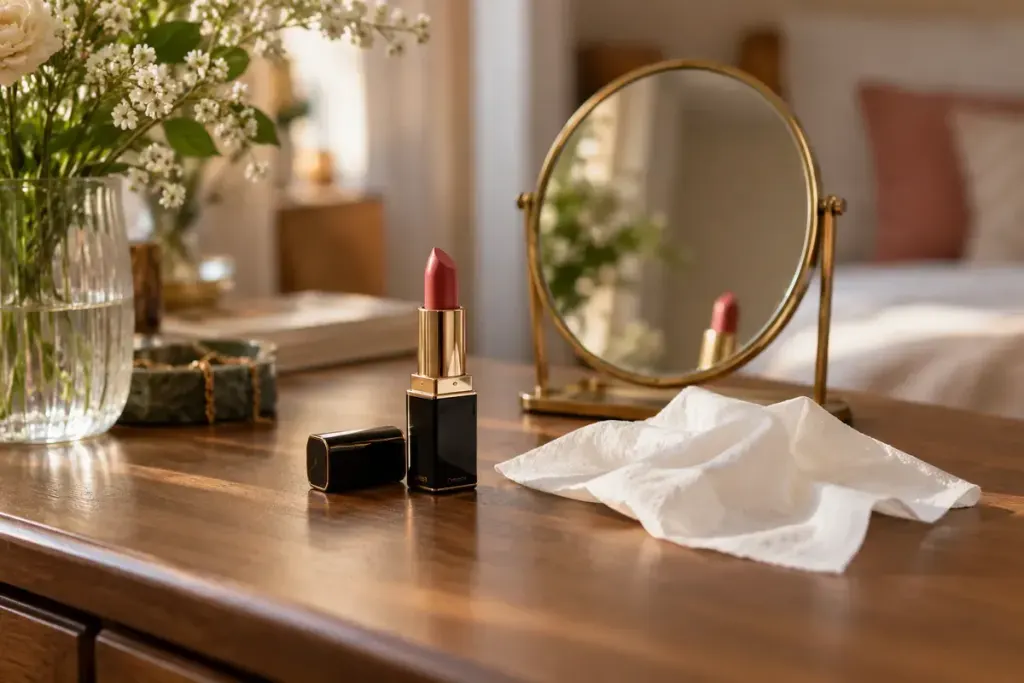
A fresh lipstick mark on a tissue does not always describe how the product will behave once its instructed setting time has passed. Conversely, a clean first blot does not promise that a colour will remain unchanged through a whole meal. A useful wear test asks a smaller, clearer question.
Begin with the product’s own directions
Apply the product as directed, including any instructions about preparation, layers or setting. Do not assume a cream lipstick and a product marketed to set into a film should be tested with identical application steps.
Use your own clean product and applicator. Avoid sharing a tester directly on the lips. If a product causes irritation, remove it and stop using it rather than continuing a test to obtain a result.
Keep the comparison modest
After the recommended waiting period, make a light, consistent contact with a clean tissue. Record what you can actually see: the amount and location of colour transferred, and whether the lip finish has changed. Avoid repeatedly pressing harder until the test becomes a rubbing exercise.
For an illustrative comparison, one application leaves a strong central mark while another leaves a faint outline. That observation is useful only alongside the application and waiting conditions. It does not establish a laboratory rating or prove that every wearer will see the same result.
Look at the lips as well as the tissue
A product can leave little colour on paper while becoming patchy or uncomfortable. Check the edges, centre and any areas that have gathered product. Note comfort in ordinary language rather than treating dryness as evidence that a formula is working better.
If you later test a drink or meal, record it as a separate stage. Different contact, food and wear time make it a different observation. Avoid turning one cup test into a claim that a product is completely transfer-proof.
A short note with application, waiting period and visible result is enough for a personal comparison. It helps you choose a finish that works in your routine without asking a single tissue mark to predict an entire day.