
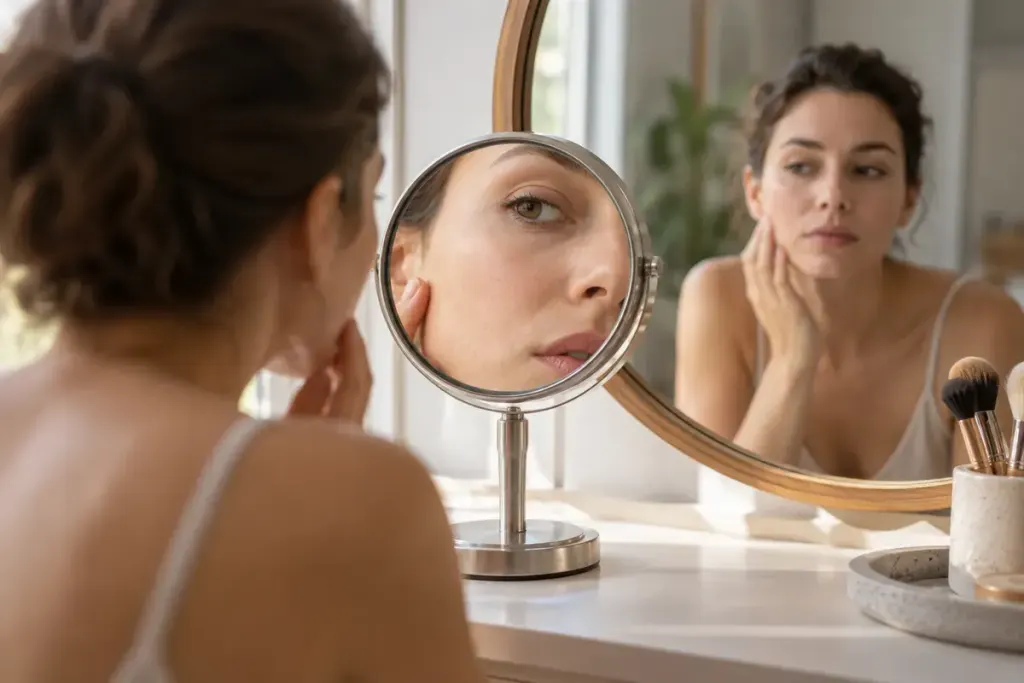
A magnifying mirror can help you see a small edge clearly. It can also make every patch of natural texture look like a problem that needs more product. Before adding another layer, step back to an ordinary mirror.
Give each mirror a job
Use close magnification for a defined task, such as checking the edge of a lip colour. Then return to a normal view to judge the overall balance. The distance at which you inspect a tiny detail is not the distance at which people usually see your whole face.
Keep the lighting reasonably consistent during the comparison. A harsh lamp placed close to the skin can emphasise texture differently from diffuse daylight. Do not change the mirror, light and product quantity all at once and assume the product alone caused the difference.
Check the relationship between areas
Look at the face as a whole: do the cheeks, eyes and lips carry the amount of emphasis you intended? One slightly uneven line may matter less than a strong patch of colour that becomes obvious only when you see both sides together.
For an everyday routine, try a simple pause after each major step. Put the brush down, move back and look before deciding whether more is needed. If you do add product, use a small amount and reassess. The pause is especially useful when a close mirror has encouraged repeated touching of the same area.
Photographs can offer another perspective, but camera processing and lighting change their appearance too. Treat a quick phone picture as an additional view, not an objective score of your skin.
You may find that the makeup already looks finished at an ordinary distance. That is a useful stopping point. A detail tool should help with a detail; it does not need to define the standard for every visible pore or fine line.