
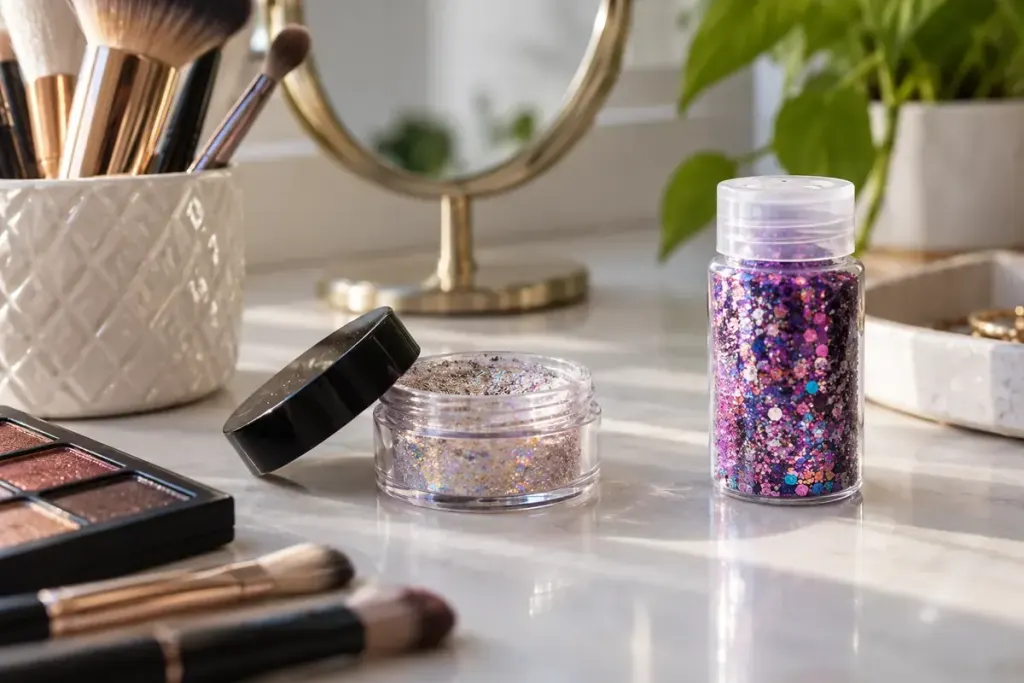
Two jars can sparkle in the same colour and still be intended for completely different uses. Glitter sold for paper crafts should not become eye makeup because it resembles a cosmetic product on camera.
The FDA’s eye-cosmetic safety guidance advises using products intended for the eye area. In the United States, permitted colour-additive uses also depend on where a product is applied; the FDA explains those distinctions in its colour-additive fact sheet.
Read the intended-use wording
Look at the actual package, not only a seller’s photograph or a creator’s demonstration. A product described for the face or body is not automatically intended for use around the eyes. If the label excludes the eye area, respect that restriction.
Ask the manufacturer for clarification when the intended use is unclear. A generic phrase such as “cosmetic glitter” should not replace the specific directions and warnings for that product. Do not assume that adding a makeup adhesive changes the suitability of craft particles.
Keep the supplies separate
If you also craft, store those materials away from makeup and label containers clearly. Decanting both into matching unmarked pots creates an avoidable identification problem. Keep the original product information, including the ingredients and use instructions.
For a planned look, choose a suitable product and learn its application and removal directions before the occasion. Do not improvise near the eyes in a moving vehicle or borrow an applicator that has been used by someone else.
Stop using a product that causes irritation. Seek appropriate medical advice for persistent symptoms or an eye injury rather than trying to conceal the problem with more makeup. Product selection and gentle handling are more useful than assuming that a small quantity cannot cause trouble.
The visual effect is only one part of the choice. The label should establish where the product belongs before the sparkle becomes part of the look.