
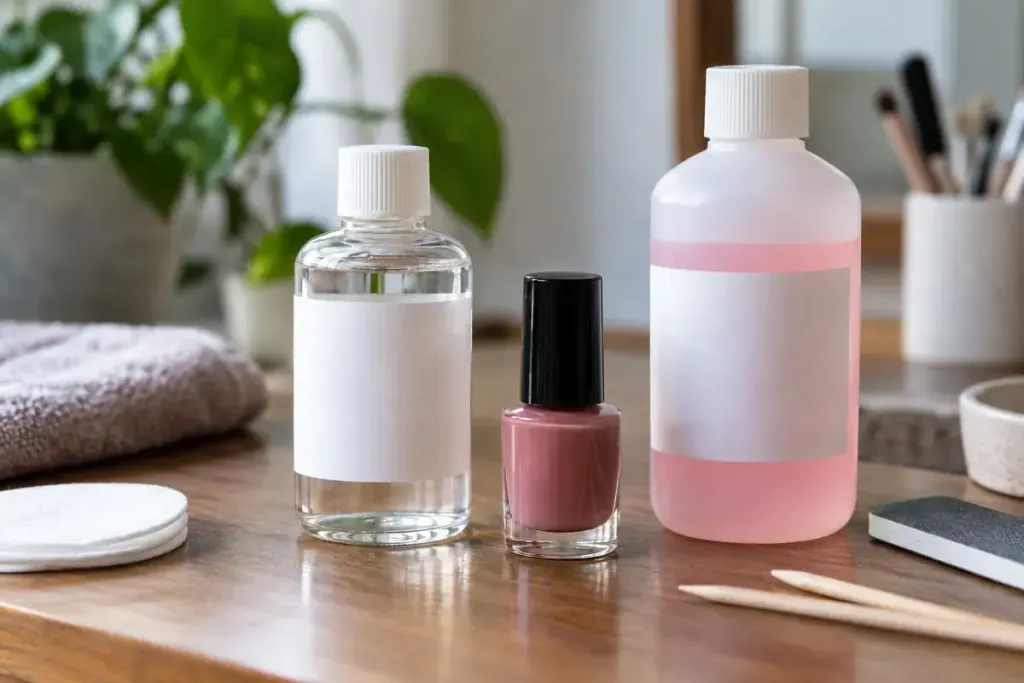
A thickened lacquer and a finished manicure both involve nail polish, but they call for different products. A thinner is intended to adjust the consistency of compatible lacquer. A remover is intended to take a coating off the nail. Similar-looking bottles do not make those jobs interchangeable.
OPI’s Nail Lacquer Thinner page, for example, describes a consistency-adjusting product and lists butyl acetate and ethyl acetate. That is information about that product, not a recipe for mixing your own solvent or proof that it suits every polish system.
Identify the coating before choosing the liquid
Check whether you are working with ordinary air-drying lacquer, a gel system or another product. Use the maker’s instructions for that exact range. A thinner recommended for lacquer should not be assumed suitable for lamp-cured gel, nail adhesive or a specialist treatment.
Read the amount and mixing directions on the bottle. Avoid copying a universal drop count from a different product: bottle volume, starting consistency and formulation can differ. Never add household solvent or remover as an improvised substitute.
Decide whether the bottle is worth adjusting
First examine its condition and the manufacturer’s use-after-opening or disposal guidance. Thinning does not establish that an old, contaminated or otherwise deteriorated product is suitable to use. If the formula’s condition is uncertain, ask the maker rather than repeatedly adding liquid until it looks workable.
For a compatible product in usable condition, follow its directions and check application on an appropriate practice surface before doing the whole manicure. Look at how it spreads, not just how freely it moves inside the glass.
Work with the ventilation and handling precautions on the labels, away from heat and flames. Keep products in their labelled containers. When putting the supplies away, group them by purpose so tomorrow’s removal step does not become today’s accidental formula change.