
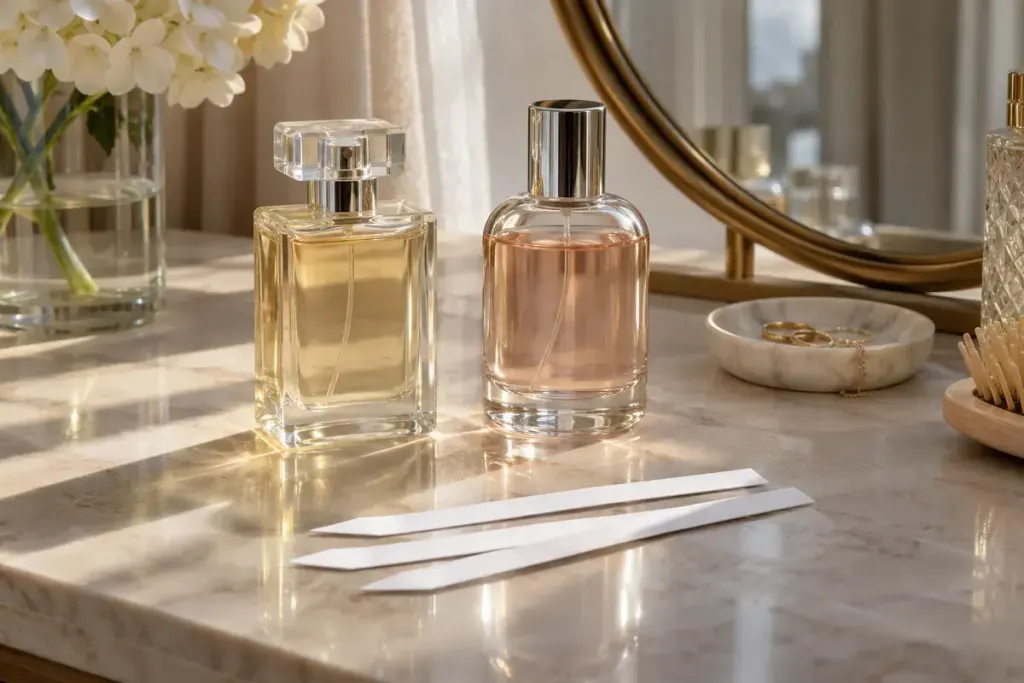
Two bottles share a fragrance name, but one says eau de toilette and another eau de parfum. It is tempting to imagine one identical scent with a simple strength slider. In practice, the label is a starting point for comparing the actual products.
Dior’s explanation of fragrance categories describes eau de toilette, eau de parfum and parfum in terms of typical concentration ranges. Those ranges are not a universal promise about how many hours a particular fragrance will remain noticeable on every wearer.
Compare versions as separate experiences
Read each product’s own description and ingredient information. Do not assume that increasing concentration leaves every other aspect unchanged. If you are considering two versions, label separate blotters with the full names and the time of testing.
Smell them again after the first impression has settled rather than deciding only from the opening spray. Keep the amount and testing conditions reasonably consistent. Sampling many fragrances in quick succession can make a careful comparison harder.
If testing on skin is appropriate for you, follow the product’s instructions and your own history of sensitivities. Avoid applying several candidates to the same area and then trying to identify which one produced the result. Stop use and seek suitable advice if irritation occurs.
Choose for the way you intend to wear it
A preference for a lighter impression, a particular development or a discreet application is more informative than assuming the highest concentration must be best. Consider shared spaces and fragrance sensitivities around you as well as your own preference.
Keep a small note of the exact version and what you noticed over time. That prevents a later purchase of a similarly named bottle from becoming an accidental substitution. The useful question is whether this formulation suits you, not whether its category wins a universal contest for strength.